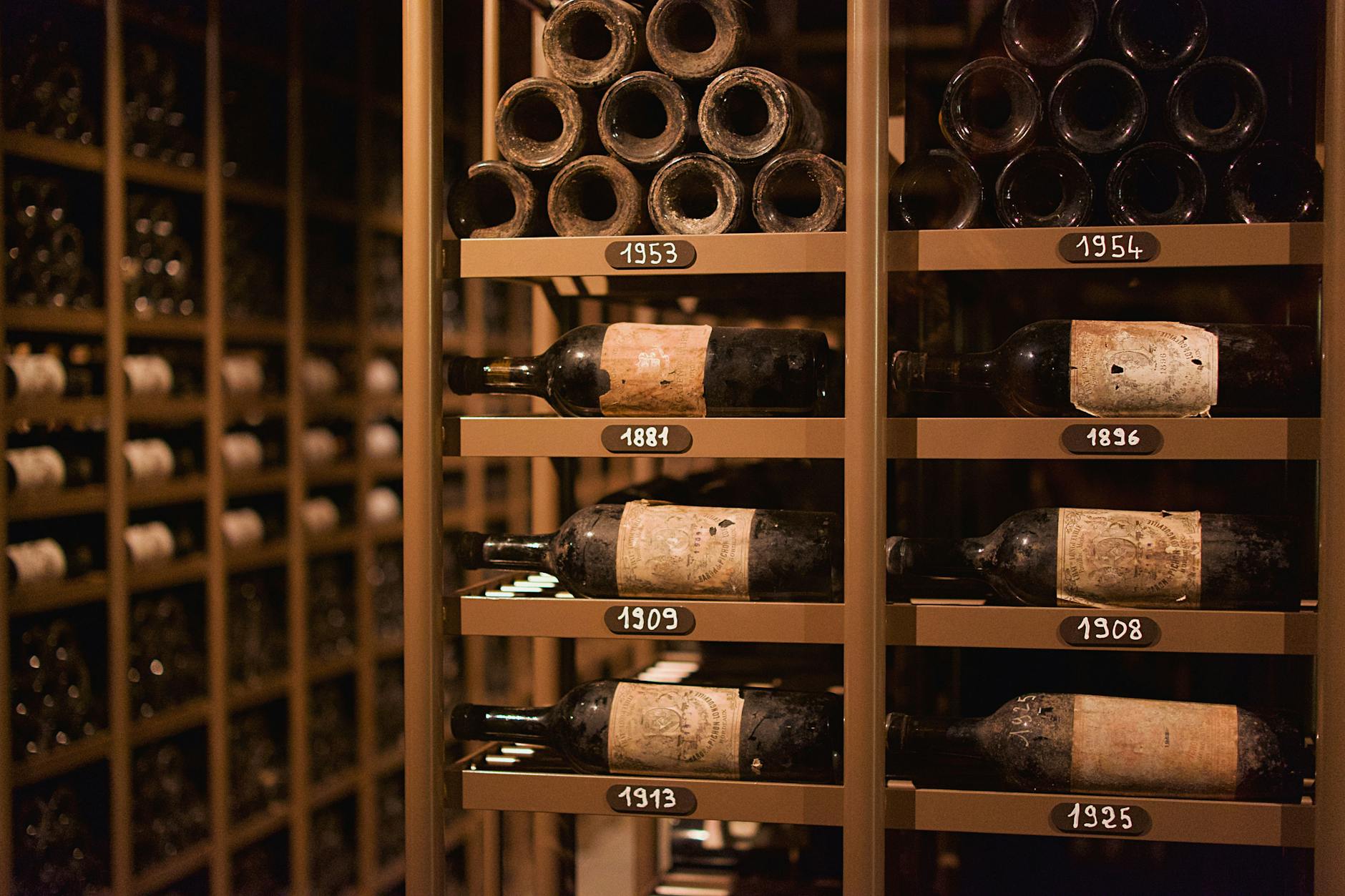
Fine wine has delivered 8-10% annualised returns over a decade per Liv-ex data. Fixed supply, rising Asian demand, and a functioning secondary market via Sotheby's and Christie's make it a credible portfolio diversifier for high-net-worth investors.
Why Is Fine Wine Attracting Serious Investment Capital Right Now?
Fine wine investment is attracting serious capital because the Liv-ex Fine Wine 1000 index — the broadest benchmark for the secondary market — delivered a 30% return over the five years to 2023, comfortably outpacing global equities during the same period of elevated volatility. At Christie's Geneva sale in May 2023, a single lot of 12 bottles of Domaine de la Romanée-Conti 2018 hammered at CHF 150,000 (approximately £135,000), underscoring the depth of demand at the top end of the market. These are not outlier results; they reflect a structural shift in how family offices and high-net-worth individuals are thinking about portfolio construction.
If you manage a diversified portfolio, the case for fine wine deserves your attention — not as a lifestyle indulgence, but as a demonstrably uncorrelated asset class with measurable price appreciation, a functioning secondary market, and supply dynamics that structurally favour long-term holders. The numbers are now compelling enough that institutions are paying attention, and retail access through specialist platforms has lowered the barrier to entry significantly.
The Liv-ex Fine Wine 1000 delivered a 30% return over five years to 2023 — outpacing global equities during volatile periods in a generation.
What Is Fine Wine as an Investment Asset?
Fine wine as an investment asset is a category of physical, collectible goods — primarily bottles and cases from top Bordeaux châteaux, Burgundy domaines, and a growing roster of New World producers — whose value appreciates over time due to scarcity, provenance, and demand from a globally expanding collector base. Unlike equities or bonds, fine wine is a tangible asset: you own the physical bottles, stored in a bonded warehouse, and your returns are realised through resale on the secondary market via auction houses such as Sotheby's, Christie's, or specialist platforms like Wine Lister and Liv-ex. The asset class has no dividend yield, but its total return is driven entirely by price appreciation, making storage costs and provenance documentation the primary operational considerations for investors.
The mechanics are straightforward. Investors typically purchase wine either en primeur — buying futures on a vintage before it is bottled, at a discount to expected release price — or on the secondary market as mature stock. The most liquid segment of the market centres on Bordeaux First Growths: Château Lafite Rothschild, Château Latour, Château Margaux, Château Haut-Brion, and Château Mouton Rothschild. Burgundy, led by Domaine de la Romanée-Conti (DRC), commands the highest per-bottle prices, with individual bottles of DRC Romanée-Conti regularly exceeding £15,000 at auction. Champagne, particularly aged vintage releases from Krug and Dom Pérignon, has also emerged as a credible sub-category with strong auction momentum.
Is Fine Wine a Good Investment Compared to Other Alternative Assets?
Fine wine is a good investment relative to many alternative assets because it combines low correlation to public markets with a long track record of real returns. According to Liv-ex data, the Fine Wine 100 index — tracking the most traded 100 wines — posted annualised returns of approximately 8-10% over the decade to 2022, a figure that compares favourably to the average annual return of the FTSE 100 over the same period, and with significantly lower volatility during equity market drawdowns. During the 2008 financial crisis, fine wine prices dipped modestly but recovered within 18 months, while equity markets took years to reclaim their highs. This defensive characteristic is precisely what makes fine wine attractive as a portfolio diversifier rather than a core holding.
Compared to other alternative assets tracked by ByProvenance — whisky casks, watches, and art — fine wine occupies a middle ground. Rare Scotch whisky casks have delivered exceptional returns (Rare Whisky 101 data shows the Apex 1000 index appreciating over 400% between 2010 and 2020), but the market is less liquid and harder to value. Blue-chip art offers comparable diversification benefits but requires far larger minimum investments and has an even thinner secondary market. Fine wine sits in a sweet spot: accessible entry points from £1,000 per case, a functioning global secondary market, and price transparency via Liv-ex's real-time trading data.
- 5-year Liv-ex Fine Wine 1000 return (to 2023): +30%
- Annualised return (Fine Wine 100, decade to 2022): approximately 8-10% per annum
- Christie's DRC 2018 hammer price (May 2023): CHF 150,000 per 12-bottle lot
- Minimum viable entry point: from £1,000 per case for Bordeaux Second Growths
- Market size: the global fine wine market was valued at approximately $50 billion in 2022, with secondary trading volumes on Liv-ex exceeding £60 million annually
Why Do Supply Constraints Make Fine Wine Prices Rise Over Time?
Supply constraints make fine wine prices rise over time because production is fixed at the vintage level: once a château bottles its 2015 Pauillac, no more of that specific wine will ever exist. Each bottle consumed permanently reduces the available supply, while demand from emerging wealth centres — particularly in Asia, where Chinese collectors have become the dominant buyers at Hong Kong and Singapore auction sales — continues to grow. This asymmetry between shrinking supply and expanding demand is the fundamental driver of long-term price appreciation, and it is structural rather than cyclical.
Bordeaux's top estates are constrained by appellation rules that limit vineyard expansion, and the most sought-after Burgundy plots — the Grand Cru vineyards of the Côte de Nuits — are measured in hectares, not acres. DRC's Romanée-Conti vineyard, for instance, covers just 1.8 hectares and produces fewer than 6,000 bottles in a typical year. When you consider that a single serious collector might purchase 100 or more bottles from a given vintage, the arithmetic of scarcity becomes stark. Sotheby's Wine reported that its 2022 global wine auction sales totalled $108 million, with Asian buyers accounting for a rising share of top-lot purchases — a demand signal that shows no sign of reversing.
How Does Fine Wine Investment Work in Practice?
Fine wine investment works through four primary channels: en primeur purchases, secondary market acquisitions, specialist investment funds, and fractional ownership platforms. En primeur — buying wine as futures during the spring following harvest — offers the best entry prices but requires a multi-year holding period before the wine is even shipped. Secondary market purchases via Sotheby's, Christie's, or Liv-ex provide immediate ownership of mature stock but at a premium to en primeur pricing. Specialist funds such as those operated by Cult Wines or Wine Owners pool investor capital and manage diversified portfolios professionally, charging management fees in exchange for active portfolio management and storage logistics. Fractional platforms have lowered the minimum investment to as little as £100 per share in a case, making the asset class accessible to a far wider investor base than previously possible.
Storage and provenance are the two non-negotiable operational requirements. Wine must be stored in a temperature- and humidity-controlled bonded warehouse — typically costing £10-£15 per case per year — to maintain condition and therefore value. Provenance documentation, including original wooden cases, purchase receipts, and an unbroken chain of custody, is essential for achieving top hammer prices at auction. A case of Château Pétrus 2000 with impeccable provenance will consistently outperform an identical case with gaps in its ownership history. Investors should also factor in auction house buyer's premiums, typically 20-25% of the hammer price, when modelling net returns.
What Should Investors Watch in the Fine Wine Market?
Investors should watch three specific signals in 2024 and beyond: Bordeaux en primeur pricing for the 2023 vintage (released spring 2024), the trajectory of Asian demand at Sotheby's Hong Kong sales, and the Liv-ex Fine Wine 1000's monthly performance data. The 2023 Bordeaux vintage is widely regarded as high quality, and en primeur pricing will set the baseline for a decade of secondary market appreciation. If châteaux price aggressively — as they did with the overpriced 2022 campaign — investor appetite may be muted, creating secondary market buying opportunities at lower prices 12-18 months post-release. Watching the spread between en primeur release prices and secondary market values is reliable entry-timing signals available to fine wine investors.
Currency dynamics also matter. Much of the fine wine market is priced in pounds sterling or euros, meaning non-European investors benefit from favourable exchange rates during periods of GBP or EUR weakness. Asian buyers purchasing in Hong Kong dollars or Singapore dollars have enjoyed a structural currency tailwind over the past two years. Finally, keep an eye on regulatory changes in key markets: Hong Kong's zero-tariff policy on wine imports, introduced in 2008, transformed the city into Asia's fine wine hub, and any replication of that model in other Asian markets would be a significant demand catalyst.
Frequently Asked Questions
What returns can I realistically expect from fine wine investment?
According to Liv-ex data, the Fine Wine 100 index has delivered annualised returns of approximately 8-10% over the decade to 2022. However, returns vary significantly by producer, vintage, and entry price. Top Burgundy and Bordeaux First Growths have outperformed the broader index, while lesser appellations have underperformed. Investors should model net returns after storage costs (£10-£15 per case per year) and auction house premiums (20-25% of hammer price).
How liquid is the fine wine secondary market?
The fine wine secondary market is more liquid than most alternative assets but less liquid than public equities. Liv-ex facilitates real-time trading between merchants globally, and major auction houses including Sotheby's and Christie's hold dedicated wine sales multiple times per year. Top Bordeaux and Burgundy labels can typically be sold within 30-60 days; lesser-known producers may take longer to find buyers at target prices.
What is the minimum investment required to enter the fine wine market?
The minimum investment depends on the channel. Buying individual cases on the secondary market typically requires £1,000-£5,000 for entry-level investment-grade wines such as Bordeaux Second Growths. Fractional platforms allow participation from as little as £100. En primeur purchases through a merchant require a minimum case quantity, usually six or twelve bottles, with pricing varying by château and vintage.
How is fine wine stored and insured as an investment?
Fine wine held as an investment should be stored in a HMRC-approved bonded warehouse in the UK (or equivalent in other jurisdictions), keeping it outside the duty-paid system and simplifying resale logistics. Storage costs typically run £10-£15 per case per year. Insurance is available through specialist providers and is usually calculated as a percentage of the wine's current market value, typically 0.1-0.2% per annum.
💼 Interested in alternative asset investment? Speak to the team at Whisky Cask Club — Singapore's leading whisky cask investment specialists.
💼 Interested in alternative asset investment? Speak to the team at Whisky Cask Club — Singapore's leading whisky cask investment specialists.