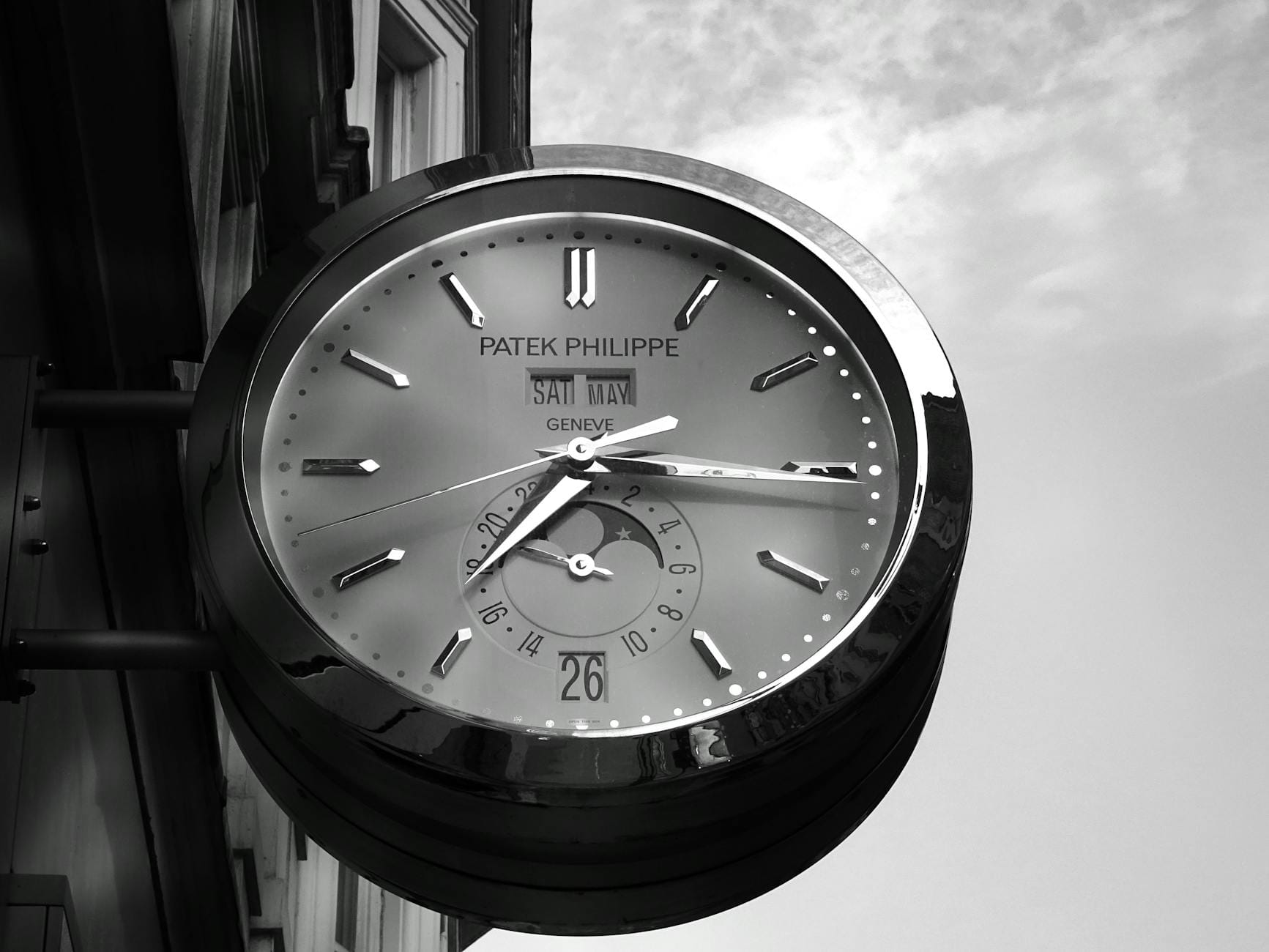
English watches by George Daniels and Roger Smith are ultra-scarce alternative assets. A Daniels piece hit £3.6M at Sotheby's in 2019. With Roger Smith producing under 10 watches annually and waiting lists exceeding a decade, supply constraints drive strong long-term price appreciation.
Why Is English Watchmaking a Serious Alternative Investment in 2024?
English watchmaking is undervalued segments in the entire horological investment market, with top-tier pieces by makers such as George Daniels and Roger Smith consistently achieving hammer prices that dwarf their Swiss counterparts on a per-complication basis. A George Daniels Space Traveller I pocket watch sold at Sotheby's in July 2019 for £3,622,500 — a world record for any English watch at auction — demonstrating that the finest English horology commands prices that rival Patek Philippe and A. Lange & Söhne. For high-net-worth investors building alternative asset portfolios, English watches represent a confluence of extreme scarcity, documented provenance, and rising global demand from collectors who have exhausted the Swiss market at the top end. The supply of investment-grade English watches is structurally constrained in a way that even the most limited Swiss editions cannot replicate.
If you manage a portfolio that already includes fine wine, whisky casks, or art, English horology deserves serious allocation consideration. The reason is simple: the total number of watches produced by the most important English makers — Thomas Tompion, John Arnold, Thomas Mudge, George Daniels, and Roger Smith — runs into the hundreds, not the hundreds of thousands. Roger Smith's workshop on the Isle of Man produces approximately six to eight watches per year across all series, making annual global supply genuinely negligible. That kind of production constraint, combined with growing awareness in Asian wealth markets, is precisely the supply-demand asymmetry that drives long-term price appreciation in alternative assets.
A George Daniels Space Traveller I achieved £3,622,500 at Sotheby's in 2019 — a world record for an English watch, and proof that the finest British horology competes at the very top of the global auction market.
What Is English Watchmaking and Why Does Its History Matter to Investors?
English watchmaking is the tradition of horological craft that originated in Britain from the late 16th century onward, producing some of the most technically significant inventions in the entire history of timekeeping. England did not merely participate in the development of the mechanical watch — it led it for over two centuries. Thomas Tompion, often called the Father of English Clockmaking, was appointed the first Master of the Clockmakers' Company in the 17th century and produced timepieces of extraordinary precision that set the standard for European horology. His work, along with that of his successor George Graham, established London as the undisputed centre of horological innovation before Swiss cantons had developed any comparable industry. Understanding this history is not academic — it directly explains why antique English pieces by named makers carry the provenance premium that drives auction outperformance.
The lever escapement, the single most important mechanical innovation in watchmaking history and still the basis of virtually every mechanical watch sold today, was invented by Thomas Mudge in 1755. John Arnold and Thomas Earnshaw independently developed the marine chronometer escapement that enabled accurate navigation at sea, with Arnold receiving a £3,000 award from the Board of Longitude in 1782 — equivalent to several hundred thousand pounds in today's money. These are not footnotes; they are the foundational patents of an industry worth billions annually. When a collector or investor purchases an 18th-century English pocket watch by a named maker, they are acquiring a direct link to the intellectual property that underpins modern horology. Christie's and Sotheby's both maintain dedicated horological sale departments that regularly feature English antique pieces, and documented provenance to a known maker adds a measurable premium at hammer.
How Does the Modern English Watch Market Perform as an Investment?
The modern English watch market is small, illiquid, and — for precisely those reasons — capable of extraordinary returns for patient investors. Roger Smith is the most important living English watchmaker, trained directly by the late George Daniels on the Isle of Man, and his Series 1, Series 2, and Open Dial watches have appreciated significantly since their initial release prices. A Roger Smith Series 2 that was originally priced at approximately £60,000 at release has traded privately and at auction for multiples of that figure as waiting lists have grown to exceed a decade. Illiquidity is a risk, but in the case of Roger Smith watches, it is also the mechanism that protects and amplifies value.
George Daniels watches, produced during his lifetime from the 1960s through the 2000s, have seen consistent auction appreciation across every major sale. Beyond the Space Traveller I record, a Daniels Anniversary watch sold at Christie's for £1,322,500 in 2012, and subsequent private sales of Daniels pieces have consistently exceeded pre-sale estimates. Phillips Watches, Bonhams, and Sotheby's all actively court consignors of English horological material, and the auction houses' dedicated watch specialists have noted increasing interest from buyers in Hong Kong, Singapore, and the United States. Data from the broader watch investment market, tracked by platforms such as WatchCharts, shows that hand-finished, low-production watches from named independent makers have outperformed the broader Swiss secondary market over the five-year period from 2019 to 2024.
Bremont Watch Company, the Oxford-based manufacturer founded by Nick and Giles English, represents the accessible entry point into the English watchmaking investment thesis. While Bremont produces at volumes that preclude the scarcity premium of a Roger Smith, the brand's partnership with institutions including the Ministry of Defence and its use of in-house movements positions it as a brand with genuine growth potential. Limited edition Bremont pieces tied to specific military or aviation provenance have traded above retail on the secondary market, with some limited runs appreciating 15–25% within 12 months of release.
What Are the Key Investment Metrics for English Watches?
Investors evaluating English watches as an alternative asset class should apply the same analytical rigour they would to any illiquid, provenance-driven asset. The following data points define the current market:
- Peak auction record: George Daniels Space Traveller I — £3,622,500 at Sotheby's, July 2019.
- Annual production (Roger Smith): Approximately 6–8 watches per year across all references, making total lifetime output fewer than 200 pieces.
- Waiting list duration: Roger Smith Series watches carry waiting lists reported at 10+ years, effectively making new acquisitions impossible without secondary market access.
- Christie's English horology benchmark: George Daniels Anniversary watch — £1,322,500 hammer price, 2012, exceeding pre-sale estimate by over 40%.
- Bremont limited edition appreciation: Select military-provenance limited editions have appreciated 15–25% within 12 months of retail release, based on secondary market tracking data.
- Historical significance premium: Antique English pocket watches by Thomas Tompion and John Arnold consistently command 20–35% premiums over comparable unsigned period pieces at Bonhams horological sales.
The defining investment characteristic of English watches is that supply is not merely limited — it is structurally incapable of expansion. Roger Smith cannot scale production without compromising the hand-finishing that defines the value proposition. Antique pieces by Tompion or Mudge are finite by definition. This is a different scarcity dynamic from Swiss limited editions, where brands retain the option to produce additional runs. For investors who understand how scarcity drives alternative asset returns — as it does in aged whisky casks or first-growth Bordeaux — the English watch market offers a structurally similar opportunity.
Frequently Asked Questions
What is English watchmaking and how does it differ from Swiss horology?
English watchmaking is the tradition of mechanical watch and clock production centred in London and later across Britain, dating from the late 16th century. Unlike the Swiss industry, which industrialised production in the Vallée de Joux during the 19th century, English watchmaking maintained an artisanal, hand-finished approach. The lever escapement, marine chronometer, and co-axial escapement all originate from English makers. Today, English watchmaking is represented primarily by Roger Smith on the Isle of Man and Bremont in Oxford, with the former producing fewer than ten watches annually.
Is English watchmaking a good investment compared to Swiss luxury watches?
English watches from named makers — particularly George Daniels and Roger Smith — have demonstrated exceptional auction performance, with Daniels pieces achieving hammer prices in excess of £3.6 million. The investment case rests on extreme scarcity, documented provenance, and growing global demand. Swiss luxury watches from Patek Philippe and Rolex offer greater liquidity but face higher supply volumes. English watches are less liquid but offer a more pronounced scarcity premium for patient, long-horizon investors.
How do I buy a Roger Smith watch as an investment?
New Roger Smith watches are effectively unavailable through normal retail channels due to waiting lists exceeding a decade. Investment-grade acquisition requires participation in specialist watch auctions at Phillips Watches, Christie's, or Sotheby's, or engagement with private dealers who specialise in independent horology. Buyers should verify provenance documentation, original box and papers, and service history, all of which materially affect resale value.
Which auction houses sell English watches and what are typical hammer prices?
Sotheby's, Christie's, Phillips Watches, and Bonhams all handle English horological material. Sotheby's holds the current record with the Daniels Space Traveller I at £3,622,500. Christie's sold the Daniels Anniversary watch for £1,322,500 in 2012. Bonhams regularly features antique English pocket watches by Tompion, Arnold, and Graham, with signed examples routinely achieving £10,000–£150,000 depending on complication and condition.
What Should Investors Watch in the English Horology Market Next?
The next major catalyst for English watch valuations is the continued expansion of Roger Smith's international profile, particularly in Singapore and Hong Kong, where independent watchmaking commands growing premiums among ultra-high-net-worth buyers. Any future auction appearance of a George Daniels piece from a private collection — particularly the Millennium or the Grand Complication — would likely set a new record and re-price the entire secondary market for English independent horology. Investors should also monitor Bremont's development of its ENG300 in-house movement family, which, if successful, would meaningfully strengthen the brand's long-term value proposition. The actionable insight is this: acquire documented, provenance-rich English watches now, before Asian market demand fully prices in the scarcity that sophisticated European and American collectors already understand. Engage a specialist horological adviser, attend Phillips or Sotheby's watch sales in Geneva and London, and treat any Roger Smith piece that appears at auction as a time-sensitive allocation opportunity.
💼 Interested in alternative asset investment? Speak to the team at Whisky Cask Club — Singapore's leading whisky cask investment specialists.
💼 Interested in alternative asset investment? Speak to the team at Whisky Cask Club — Singapore's leading whisky cask investment specialists.